|
From 1821 to 1846, the Fur Brigade Trail was busy. Twice a year, two or three hundred pack horses and men would use the trail. These groups of men and pack animals were called pack trains or horse trains. They would take goods north and bring furs south. Each horse would carry over 150 pounds on its back and would travel about 20 miles each day. Every morning the brigade was underway by 9:00 a.m. after the horses were rounded up and loaded. After 4:00 p.m., the packers would set up camp, and the horses would be let out to graze in the wild grasslands. There were many rest areas along the trail, with grazing land and fresh drinking water for the horses. Westbank, across Okanagan Lake from Kelowna, was a popular spot for stopping. At first, the Fur Brigade Trail was mainly used by fur traders. But the fur trade route came to an end in 1846. At that time, the American border was drawn at the 49 th parallel. The British-owned Hudson’s Bay Company did not want to travel through the new American territory. So the Company stopped using the Okanagan portion of the Fur Brigade Trail between Kamloops and Fort Vancouver. |
|
|
|
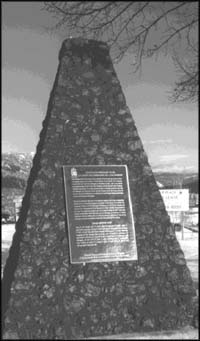
Instead, furs were brought south down the Nicola Valley to Hope and then on the Fraser River to Vancouver. However, in the Okanagan, the trail continued to be used by miners, missionaries, and other travellers. In fact, Father Pandosy, the first white settler in the Kelowna area, travelled on the Brigade Trail for part of his trip between Colville, Washington, and Kelowna. The trail was so well used that even today there are places on the west side of the lake where the trail is still visible. One can still walk part of the trail near Okanagan Lake Resort. In 1949, a cairn with a plaque telling about the Okanagan Brigade Trail was erected in Westbank. |
| This cairn marking the Okanagan Brigade Trail is located
at the corner of Highway 97 and Old Okanagan Highway. |
|