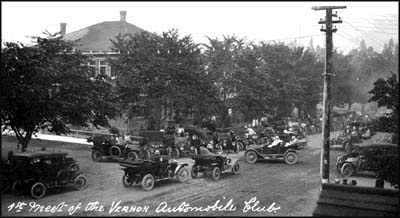
|
Over the next couple of decades, many trails and primitive roads were built that helped to open up the Okanagan Valley. The Allison Trail between Princeton and Okanagan Lake was built to move cattle from their summer grazing pastures in Princeton to their winter grounds on Okanagan Lake. There was also the Pandosy Trail that followed the east side of Okanagan Lake between Penticton and Kelowna. There was a wagon road between Spallumcheen and the head of Okanagan Lake as early as 1873. The first wagon road between the north end of Okanagan Lake and Kelowna was built in 1875. Automobiles and Highways The early roads were first used by horses and wagons. Automobiles started showing up in the Okanagan in 1904. The first car was a McLaughlin two-seater. Then came the Model T Fords. In 1919, a person could buy a Model T Ford for $600. All early Model T’s were black. The gas tank was under the front seat, and there was no fuel gauge. People had to estimate how low they were on fuel. People would buy gasoline by the barrel and keep it at home because there were no gas stations. In the early days, there were no speed limits on the roads, and no licence was needed to drive. By 1911, Vernon had passed a city bylaw setting the speed limit to 15 miles per hour (just under 25 kph). On some roads, a mixture of sand and hot tar was placed on the surface to keep the dust down. This was the start of modern pavement.
Photo courtesy of Greater Vernon Museum and Archives |