|
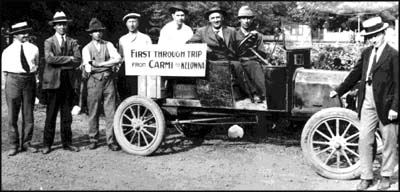
Early car owners demanded better roads in their own areas. They also wanted to travel to other towns and to other provinces. There were early attempts to drive across Canada. In 1912, an Englishman named Thomas Wilby took 52 days to get from Halifax to Victoria. He drove through swamps, forests, open prairie, and mountainous terrain. In some places he had to use a train or a boat to get through. In 1920, Percy Montgomery drove from Montreal to Vancouver in 32 days. But he dipped down into the U.S. because sections of the road in Canada hadn’t been built or were too rough. Then in 1925, two Canadians crossed Canada by car, but not always by road. They had a special set of wheels for their car that fit on railway tracks. When the driving got too difficult, they slipped on the train wheels and rode along on the tracks. Finally in 1946, two men drove from Nova Scotia to Victoria on Canadian roads. It took them nine days in a new Chevrolet.
Municipal governments constructed local streets, and the provincial government built roads linking towns in the province. By 1940, there was a two-lane highway built across BC. But there was no highway stretching across Canada from coast to coast. Railways had been crossing the country for years. And in 1937, Trans-Canada Airlines, now Air Canada, began flying across the country. But there was still no continuous highway. The federal government in Ottawa would need to give money to the provinces to help them extend their roads and make them link up with the roads of neighbouring provinces. Funding was made available, and by 1946 there was a through road across the country. However, stretches of the road were often made of gravel and were in poor condition. In 1949, Parliament passed the Trans-Canada Highway Act to provide a modern paved road. Today, the Trans-Canada Highway is the longest, fully-paved road in any country in the world. It extends 4,860 miles (about 7,820 kilometres) from Victoria, BC, to St. John’s, Newfoundland. |